
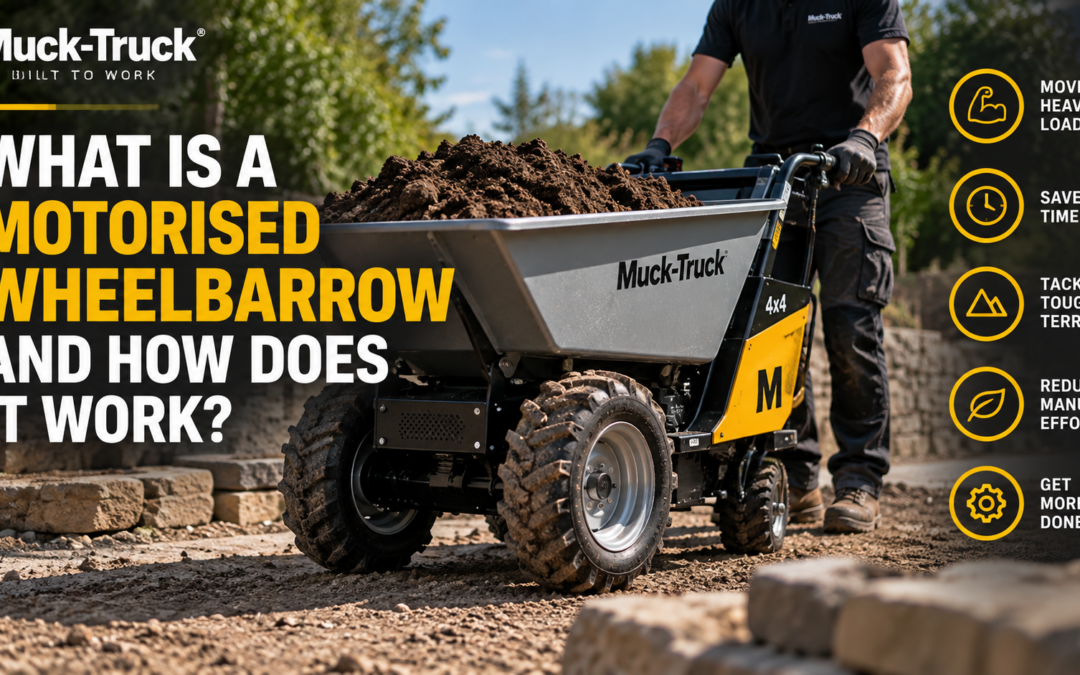
Moving heavy materials around a jobsite can be physically demanding, time-consuming work. Traditional wheelbarrows are useful for smaller loads, but when you need to transport soil, gravel, concrete, landscaping materials or construction debris repeatedly, manual handling can quickly become inefficient.
A motorized wheelbarrow provides a powered alternative.
A motorized wheelbarrow is a compact, self-propelled machine designed to transport heavy or bulky materials with less physical effort than a conventional wheelbarrow. Instead of relying on the operator to push the entire load, an engine or electric motor powers the machine, while wheels or tracks provide traction across the worksite.
Motorized wheelbarrows are used across construction, landscaping, agriculture, property maintenance and other industries where materials need to be transported efficiently, particularly in areas where larger equipment cannot easily operate.
How Does a Motorized Wheelbarrow Work?
A motorized wheelbarrow combines a load-carrying body with a powered drive system.
Unlike a conventional wheelbarrow, where the operator must lift and push the load, the motor supplies the power needed to move the machine forwards or backwards. The operator controls its direction and speed while walking behind it.
Depending on the design, the machine may run on wheels or tracks and use either a gasoline engine or electric motor.
Many professional powered wheelbarrows also incorporate tipping mechanisms that make unloading materials significantly easier.
The overall principle is simple: the machine handles much of the physical work involved in transporting the load, allowing the operator to concentrate on safely controlling and positioning it.
What Are the Advantages of a Motorized Wheelbarrow?
The biggest advantage is reduced physical effort, but there are several reasons businesses and contractors choose motorized equipment over traditional wheelbarrows.
Move Heavier Loads More Easily
Moving a fully loaded conventional wheelbarrow requires considerable physical effort, particularly when working on uneven or sloping ground.
A motorized machine provides powered movement, making it much easier to transport heavier loads.
The maximum payload will vary according to the individual model, so users should always follow the manufacturer’s stated load capacity.
Improve Productivity
Moving more material per journey can reduce the number of trips required across a jobsite.
The powered drive also means operators do not have to expend as much energy moving each load.
For construction and landscaping companies, these time savings can add up considerably over the course of a project.
Reduce Manual Handling
Repeatedly pushing heavily loaded wheelbarrows can place significant physical demands on workers.
A motorized wheelbarrow does not eliminate the need for correct handling procedures, but its powered movement can reduce the amount of force required to transport materials.
Access Confined Areas
One of the biggest advantages of compact powered dumpers is their ability to work in locations that may be difficult to access using larger construction equipment.
This can make them useful for gardens, pathways, residential construction sites and other confined spaces.
Always check the dimensions of a particular model if access through gates, doorways or narrow routes is important.
What Can You Carry in a Motorized Wheelbarrow?
Motorized wheelbarrows can be used to transport a wide range of materials depending on the machine and body or attachment fitted.
Typical loads include:
- Soil and topsoil
- Sand
- Gravel and aggregate
- Mulch
- Landscaping materials
- Construction debris
- Bricks and blocks
- Concrete
- Logs and timber
- Garden waste
- Tools and equipment
This versatility makes compact mini dumpers suitable for many different industries.
Different bodies and attachments may also allow the same base machine to perform additional jobs, increasing its usefulness throughout the year.
Motorized Wheelbarrow vs Traditional Wheelbarrow
The fundamental difference is how the load is moved.
With a conventional wheelbarrow, the operator provides almost all of the energy. They lift the handles, balance the load and push it forwards.
A motorized version uses an engine or motor to propel the machine.
This distinction becomes increasingly important as loads become heavier, distances become longer or terrain becomes more challenging.
Traditional wheelbarrows remain practical for occasional light-duty jobs. They are inexpensive, simple and require little maintenance.
However, professional users who move materials regularly may benefit from the additional carrying capability, traction and productivity offered by a powered machine.
Are Tracked Motorized Wheelbarrows Better?
Tracked machines can provide significant advantages when working on difficult terrain.
Rather than relying on individual wheels, a tracked wheelbarrow uses tracks to provide a larger contact area with the ground.
This can improve traction on surfaces such as mud, loose soil and uneven ground.
Tracked machines can therefore be particularly useful on construction sites, landscaping projects and other locations where ground conditions are less predictable.
Whether tracks are the best choice depends on where the machine will be used.
For relatively flat, firm surfaces, wheeled equipment may provide all the capability required. For rougher conditions, tracks can provide additional stability and traction.
Gas vs Electric Motorized Wheelbarrows
Motorized wheelbarrows are available with different power systems. Two of the main choices are gasoline and electric.
Gas-Powered Wheelbarrows
Gas-powered machines have traditionally been popular for professional and demanding applications.
They can provide the power and runtime required for jobs where the machine will be used repeatedly throughout the working day.
Refueling is also relatively quick, making gasoline equipment suitable for locations where charging facilities are limited.
However, gasoline engines produce exhaust emissions and more operating noise than electric alternatives and require regular engine maintenance.
Electric Wheelbarrows
Battery-powered equipment has become increasingly important as electric technology has improved.
An electric motorized wheelbarrow can provide quieter operation and eliminates exhaust emissions at the point of use.
This can make electric models particularly attractive for residential environments, indoor or enclosed applications where suitable, and locations where noise needs to be minimized.
The main consideration is battery capacity and charging.
Users need to ensure the machine provides sufficient runtime for the intended workload and that suitable charging arrangements are available.
Which Is Better: Gas, Electric or Tracked?
These categories are not necessarily direct alternatives.
“Gas” and “electric” describe how the machine is powered, while “tracked” describes how it travels across the ground. A machine can therefore be both powered by an engine and tracked.
The right configuration depends on the application.
A landscaping contractor working across muddy or uneven sites may prioritize traction and load capacity. A business operating in noise-sensitive environments might place greater importance on electric power.
Before choosing a machine, consider the typical terrain, loads, daily operating time, access restrictions and working environment.
Where Are Motorized Wheelbarrows Used?
Their compact dimensions and material-handling capabilities make motorized wheelbarrows useful across many industries.
In construction, they can transport materials and debris around sites where larger dumpers may be impractical.
Landscapers can use them for moving soil, mulch, gravel, plants and other materials around gardens and commercial landscapes.
They can also be useful in agriculture, grounds maintenance and property management.
For homeowners tackling larger renovation or landscaping projects, a motorized machine can make moving substantial quantities of material considerably easier.
How Much Can a Motorized Wheelbarrow Carry?
Load capacity varies considerably between machines.
Rather than assuming every motorized wheelbarrow can handle the same weight, check the rated payload of the specific model you are considering.
It is also important to think about the type of material being transported.
A container filled with dry leaves will weigh considerably less than the same volume of gravel or wet soil.
Never exceed the manufacturer’s rated capacity, and make sure the load is distributed appropriately.
What Should You Look for When Choosing a Motorized Wheelbarrow?
Start by considering what you will actually ask the machine to do.
Payload capacity is important, but it should not be the only consideration.
Think about the terrain, width restrictions and distance materials typically need to travel. Consider whether tracks or wheels are more appropriate and whether gasoline or electric power better suits the working environment.
Also look at the available attachments.
A versatile machine that can be adapted to different jobs may offer greater long-term value than equipment designed for only one task.
Professional users should also consider durability, maintenance requirements, parts availability and manufacturer support.
Is a Motorized Wheelbarrow Worth It?
For anyone regularly transporting heavy materials, a motorized wheelbarrow can provide significant advantages over a conventional wheelbarrow.
Powered movement reduces the physical effort needed to transport loads, while larger carrying capacities can improve jobsite productivity.
They are particularly useful where access prevents the use of larger machinery.
For contractors, landscapers and other professional users, the ability to move materials efficiently can help reduce labor-intensive manual handling and keep projects progressing.
Discover Muck-Truck Motorized Wheelbarrows
A motorized wheelbarrow bridges the gap between a traditional manual wheelbarrow and larger material-handling equipment.
Compact, maneuverable and designed to transport substantial loads, these machines can provide an efficient solution for construction, landscaping, agriculture and many other demanding applications.
Whether you need the runtime of a gas-powered machine, the quieter operation of an electric option or the additional traction provided by tracks, the key is choosing equipment that matches your workload and environment.
Muck-Truck offers compact powered dumpers and material-handling solutions designed to help professionals move heavy loads efficiently across demanding jobsites.
Explore the Muck-Truck range to find the right material-handling solution for your next project.