
When it comes to securing your property while improving convenience and kerb appeal, automated gates are one of the most effective investments you can make. Whether for a residential driveway, commercial premises, or industrial site, gate automation offers added security, privacy, and ease of access.
Two of the most popular choices are sliding gates and swing gates, but which automation system is best for your property?
The answer depends on several factors, including the amount of available space, the style of your entrance, your budget, and how frequently the gate will be used. Companies such as EasyGates offer a wide range of gate automation kits, motors, accessories, and professional guidance to help homeowners and businesses choose the right solution.
In this guide, we’ll compare sliding and swing gate automation systems to help you decide which option is best suited to your needs.
What Is a Swing Gate?
Swing gates operate much like a standard door, opening inward or outward on hinges. They are commonly seen on residential driveways and can be designed as either single-leaf or double-leaf gates.
Automation is typically achieved using underground motors, ram arms, or articulated arm operators, allowing the gates to open automatically via remote control, keypad, intercom, or smartphone integration.
Benefits of Swing Gates
Traditional Appearance
Swing gates are often considered the more classic and elegant option. They work particularly well with period properties, rural homes, and traditional driveway entrances.
Cost-Effective Installation
In many cases, swing gate systems are less expensive to install than sliding gates because they usually require less groundwork and fewer structural modifications.
Wide Range of Automation Options
Modern swing gate automation systems are available for wooden, aluminium, steel, and wrought iron gates. Suppliers like EasyGates provide automation kits suitable for both light residential use and heavy-duty commercial applications.
Drawbacks of Swing Gates
Requires More Space
Swing gates need enough clearance to open fully. If your driveway slopes upward or you have limited space behind the gate, installation can become difficult.
Wind Resistance
Large solid swing gates can catch the wind, placing additional stress on motors and hinges. This can reduce performance during poor weather if the system is not properly specified.
Slower Operation
Double swing gates generally take longer to open and close compared to sliding systems.
What Is a Sliding Gate?
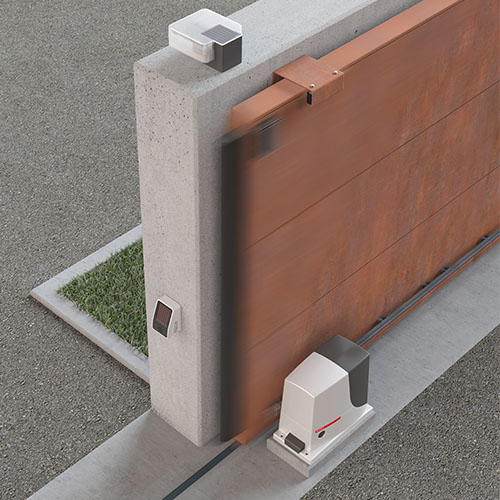
Sliding gates move horizontally along a track, opening sideways rather than swinging inward or outward. They are commonly used on commercial sites, industrial premises, and modern residential properties where space is limited.
Automation is achieved using a motorised gear rack system, which smoothly slides the gate open and closed.
Benefits of Sliding Gates
Ideal for Limited Space
One of the biggest advantages of sliding gates is their space efficiency. Because the gate slides sideways, there’s no need for clearance behind the gate.
This makes sliding systems ideal for short driveways or properties located close to roads.
Better Security
Sliding gates are generally considered more secure because they are harder to force open. The gate is firmly held on its track, making unauthorised access more difficult.
Suitable for Sloping Driveways
Unlike swing gates, sliding gates can work well on driveways with gradients or uneven terrain.
Reliable for Heavy Usage
Sliding gate automation systems are commonly used in commercial and industrial environments due to their durability and ability to handle frequent opening cycles.
Drawbacks of Sliding Gates
Higher Installation Costs
Sliding gates often require more extensive groundwork, including a concrete track foundation. This can increase installation costs compared to swing systems.
More Maintenance
Tracks must be kept clean and free from debris to ensure smooth operation. Leaves, dirt, and ice can occasionally interfere with movement if not maintained properly.
Requires Side Clearance
Although sliding gates save space in front of the driveway, they do require enough room to one side for the gate to retract fully.
Which Automation System Is Best for Residential Properties?
For many UK homeowners, swing gate automation remains the most popular choice due to its traditional appearance and lower installation costs.
However, sliding gates are becoming increasingly popular for modern homes, particularly where space is restricted or enhanced security is a priority.
You may prefer swing gates if:
- You have a long, flat driveway
- You want a traditional or decorative appearance
- You’re working with a smaller budget
- You prefer simpler installation
You may prefer sliding gates if:
- Your driveway has limited depth
- Your property sits close to the road
- You need enhanced security
- Your driveway slopes uphill
Which Is Better for Commercial Premises?
For commercial and industrial properties, sliding gates are often the preferred solution. They are robust, secure, and better suited to handling high traffic volumes.
Businesses frequently rely on sliding gate systems because they:
- Operate reliably under heavy daily use
- Provide stronger perimeter security
- Integrate easily with access control systems
- Perform well in tighter access areas
That said, swing gate automation can still be suitable for smaller business premises or private developments where aesthetics are equally important.
Choosing the Right Gate Automation Supplier
No matter which gate style you choose, selecting high-quality automation equipment is essential for long-term reliability and safety.
EasyGates supplies a comprehensive range of gate automation products, including:
- Sliding gate motors
- Swing gate automation kits
- Safety accessories
- Intercom systems
- Remote controls
- Access control solutions
With products suitable for residential, commercial, and industrial applications, EasyGates helps customers find automation systems tailored to their exact requirements.
Final Thoughts
Both sliding and swing gate automation systems offer excellent benefits, but the right choice ultimately depends on your property layout, security needs, and budget.
Swing gates are ideal for traditional properties with plenty of space, while sliding gates provide superior practicality for compact driveways and commercial settings.
Before making a decision, it’s important to assess your available space, driveway gradient, expected usage levels, and desired appearance. Working with a specialist supplier such as EasyGates can help ensure you choose a reliable, high-quality automation system that delivers convenience, security, and long-term performance.