
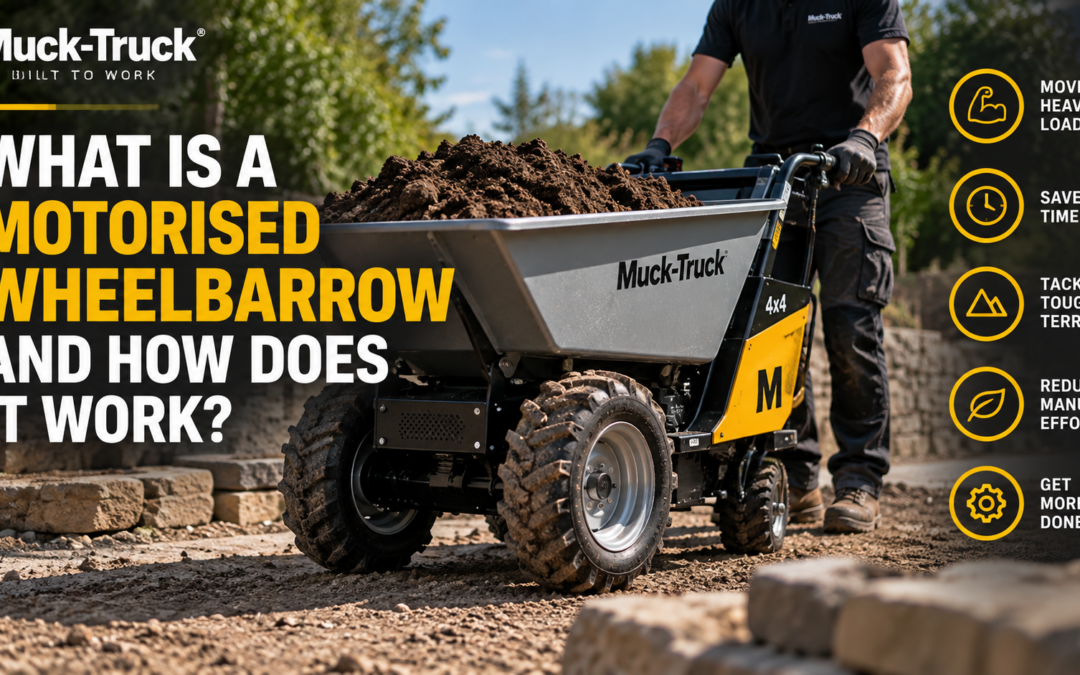
Moving soil, gravel, building materials or garden waste with a traditional wheelbarrow can quickly become tiring, particularly when you are dealing with heavy loads, slopes or uneven ground. For landscapers, builders, grounds maintenance teams and property owners, there is an easier alternative: the powered wheelbarrow.
A powered wheelbarrow is a self-propelled machine designed to transport heavy or bulky materials with considerably less physical effort than a conventional wheelbarrow. Rather than relying entirely on the operator to push the load, an engine or electric motor provides the driving force.
Also known as a motorised wheelbarrow, power barrow or mini dumper, these compact machines can be used in places where larger dumpers and construction equipment may be impractical.
How Does a Powered Wheelbarrow Work?
A powered wheelbarrow combines a load-carrying skip or platform with a powered drive system.
The operator normally walks behind the machine and uses controls mounted around the handles to control its speed and direction. Instead of physically pushing the entire weight of the machine and its contents, the drive system moves the wheelbarrow forwards or backwards.
Depending on the model, power may come from a petrol engine or an electric motor and battery system.
Some models also feature powered or hydraulic tipping mechanisms, making it easier to unload heavy materials once they reach their destination.
The result is a compact material-handling machine that can transport significantly heavier loads than most people would comfortably move with a traditional wheelbarrow.
How Is a Powered Wheelbarrow Different From a Traditional Wheelbarrow?
The most obvious difference is that a conventional wheelbarrow depends almost entirely on physical effort.
The operator must lift the handles, balance the load and push the wheelbarrow forwards. The heavier the load becomes, the more difficult this is.
A motorised wheelbarrow uses mechanical power to move the machine.
This provides several advantages when transporting heavy materials repeatedly throughout the working day.
Muck-Truck’s original mini dumper, for example, has a carrying capacity of 250kg, while larger models in the range can carry up to 365kg.
Powered models can also offer four-wheel drive and increased traction, helping operators move materials across surfaces and gradients that would be considerably more difficult with a conventional barrow.
What Are Powered Wheelbarrows Used For?
One of the main advantages of a powered wheelbarrow is its versatility.
They are particularly useful in situations where materials need to be transported repeatedly but access is too restricted for larger machinery.
Common applications include:
- Construction and building sites
- Landscaping and garden projects
- Groundworks
- Property maintenance
- Parks and recreation
- Agriculture and smallholdings
- Equestrian facilities
- Utilities
- DIY renovation projects
- Moving soil and aggregate
- Transporting paving materials
- Removing construction waste
- Moving logs, timber and garden waste
Their relatively compact dimensions can make them especially useful around residential properties and confined working areas.
The standard Muck-Truck, for example, is approximately 710mm wide, allowing it to travel through many restricted access points where larger machinery would not fit.
What Are the Benefits of a Powered Wheelbarrow?
Move More Material
One of the biggest advantages is carrying capacity.
A powered machine can transport much heavier loads than an operator would normally want to move manually.
This means fewer journeys may be required to move the same quantity of material.
Reduce Physical Effort
Repeatedly pushing heavy wheelbarrows can be physically demanding.
Because a powered wheelbarrow propels itself, the operator does not need to provide all of the force required to move the load.
This can help reduce operator fatigue, particularly during jobs involving repeated material movement.
Improve Productivity
If more material can be transported on each journey and less physical energy is required, teams can potentially complete material-moving jobs more efficiently.
This is particularly important for professional landscapers and construction businesses where labour time has a direct impact on project costs.
Work on Challenging Ground
Uneven ground, mud and slopes can make a traditional wheelbarrow difficult to control.
Powered machines with suitable traction can make these environments much easier to navigate.
The standard Muck-Truck uses four-wheel drive and is designed to climb gradients of up to 30 degrees when correctly loaded and operated.
How Much Can a Powered Wheelbarrow Carry?
The amount depends entirely on the model.
Compact powered wheelbarrows can still provide surprisingly high load capacities.
Within the Muck-Truck range, the original Muck-Truck has a rated carrying capacity of 250kg, while machines including the Max-Truck, H-Max, Max EGO and Power Barrow 4WD II offer capacities of up to 365kg.
However, operators should never assume that every powered wheelbarrow can safely carry the same amount.
Always check the manufacturer’s specifications and never exceed the rated capacity.
It is also important to remember that different materials have very different weights. A skip full of leaves or garden waste is very different from the same volume of wet soil, aggregate or concrete.
What Is a Tracked Powered Wheelbarrow?
Some powered wheelbarrows and mini dumpers use tracks rather than conventional wheels.
Tracks spread the machine’s weight over a larger contact area and can provide excellent traction on loose, wet or uneven ground.
This can make tracked machines particularly suitable for muddy construction sites, difficult landscaping projects and other challenging environments.
However, tracks are not automatically the best solution for every application.
A high-traction four-wheel-drive powered wheelbarrow can provide an effective alternative while offering good manoeuvrability and versatility.
The right choice depends on the terrain, load requirements, access restrictions and type of work being undertaken.
Petrol vs Electric Powered Wheelbarrows
One of the most important choices when buying a powered wheelbarrow is the power source.
Both petrol and electric machines have advantages.
Petrol Powered Wheelbarrows
A petrol motorised wheelbarrow is well suited to demanding outdoor applications where strong performance and convenient refuelling are priorities.
Petrol models are commonly used by builders, landscapers and other professional operators.
They can be particularly practical on sites where access to electricity or charging facilities is limited.
For example, Muck-Truck’s petrol models use commercial Honda engines, with four-wheel-drive options designed for professional material handling.
Electric Powered Wheelbarrows
An electric powered wheelbarrow replaces the petrol engine with an electric motor and battery system.
Electric models can provide quieter operation and avoid exhaust emissions at the point of use.
This makes them particularly useful in noise-sensitive environments, around animals or in applications where reducing engine noise is desirable.
Muck-Truck currently offers several electric options, including the Ladybug 2WD, Max EGO and Power Barrow 4WD II.
The Max EGO, for example, uses a 56V power system with two quick-charging lithium batteries and offers a carrying capacity of up to 365kg.
When Is an Electric Powered Wheelbarrow Most Suitable?
Electric models can be particularly attractive for gardens, residential areas, equestrian facilities and other environments where noise is an important consideration.
For equestrian users, quieter operation can be useful when working around horses and other animals.
Muck-Truck specifically highlights its battery-powered equipment for stable and equestrian applications where users may want to reduce engine noise.
Electric power can also be useful for businesses looking to reduce their reliance on petrol-powered equipment.
However, battery capacity, charging times and expected daily usage should all be considered before choosing a model.
When Is a Petrol Powered Wheelbarrow Most Suitable?
Petrol models remain an excellent choice for demanding outdoor work.
Construction sites, landscaping projects and remote locations may all benefit from the ability to refuel a machine quickly without waiting for batteries to charge.
If a powered wheelbarrow is going to be used intensively throughout the day, users should compare expected running times, refuelling or charging requirements and the type of work being completed.
There is no single option that is best for every application.
The objective should be to choose the power system that best suits the environment in which the machine will actually operate.
Can Powered Wheelbarrows Use Attachments?
Some powered wheelbarrows can become much more than simple material carriers.
Interchangeable attachments can allow the same machine to perform different jobs, helping businesses get more value from their equipment.
Depending on the machine, accessories can include flatbeds, towing equipment and other specialist attachments.
Muck-Truck’s powered wheelbarrows are designed to work with a range of interchangeable accessories, allowing machines to be adapted to different applications.
This can be particularly valuable for landscapers, builders, farms and maintenance teams that regularly carry different types of loads.
Is a Powered Wheelbarrow Worth It?
If you only move small, lightweight loads occasionally, a conventional wheelbarrow may be perfectly adequate.
However, the calculation changes when material handling becomes a regular part of your work.
If employees or operators are repeatedly moving soil, aggregate, waste, paving materials or other heavy loads, a powered wheelbarrow can significantly reduce the physical effort involved.
The combination of increased carrying capacity, powered movement, good traction and compact dimensions can also help businesses complete jobs more efficiently.
For professional applications, that can make a powered wheelbarrow a practical investment rather than simply an alternative to a manual barrow.
Choosing the Right Powered Wheelbarrow
Before buying, consider exactly where and how the machine will be used.
Think about the maximum loads you need to transport, the width of access routes, ground conditions, slopes and how frequently the machine will operate.
You should also consider whether petrol or electric power is more appropriate and whether you require features such as powered tipping, four-wheel drive or interchangeable attachments.
Comparing these factors will help you choose a machine that suits both your immediate requirements and future projects.
Discover Muck-Truck Powered Wheelbarrows
A powered wheelbarrow takes the basic idea of a traditional wheelbarrow and transforms it into a far more capable material-handling machine.
By using petrol or electric power to propel the load, these machines can help operators transport heavier materials, tackle challenging terrain and reduce the physical effort associated with conventional wheelbarrows.
From construction and landscaping to equestrian facilities and property maintenance, they provide a compact solution for jobs where larger equipment may simply be too big.
Muck-Truck designs and manufactures a range of powered wheelbarrows and mini dumpers in the UK, including petrol and electric options for different working environments.
Explore the Muck-Truck powered wheelbarrow range to compare available machines and find the right option for your workload.